
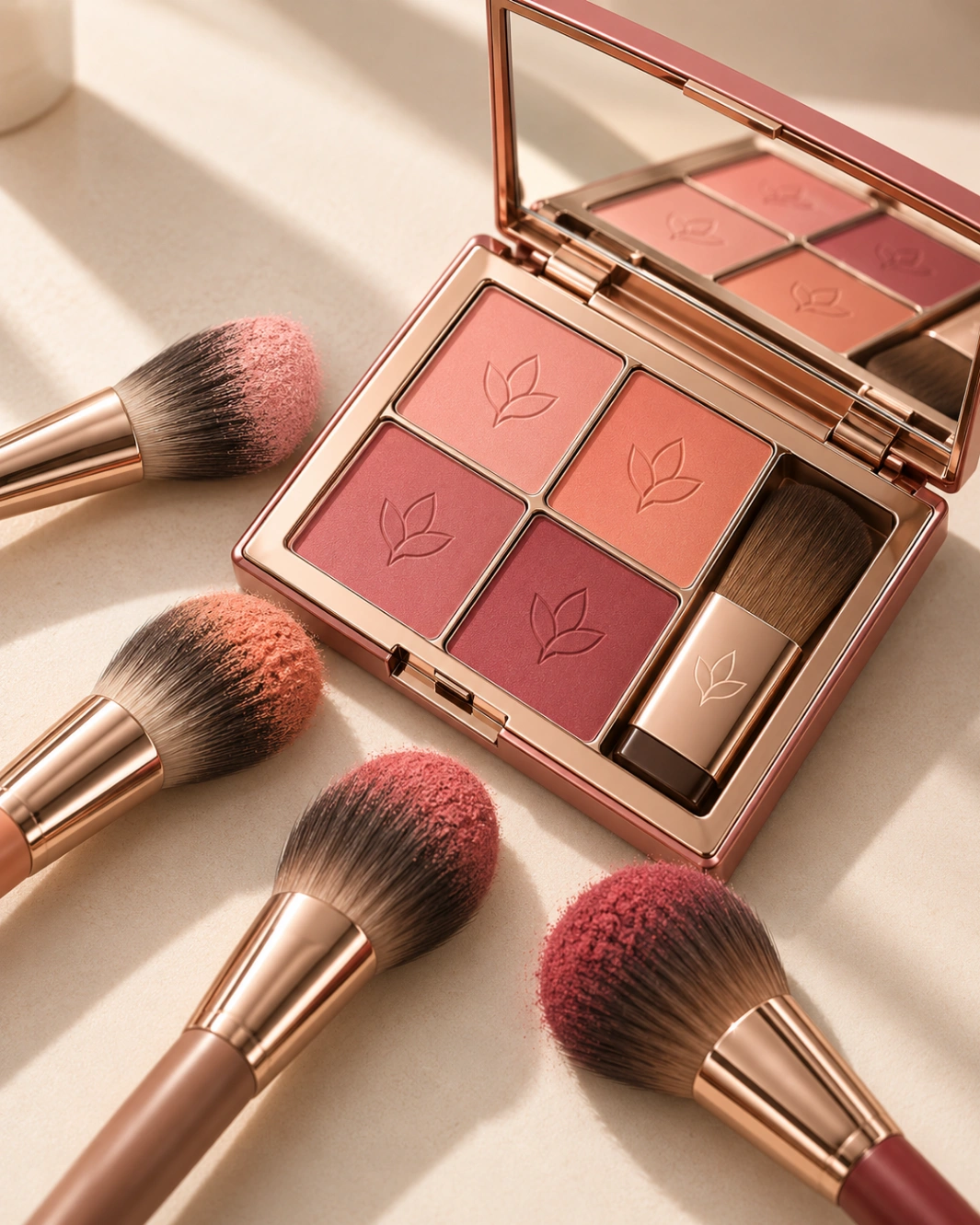
AI Product Photography Prompt: Blush Palette Still Life
Create one photorealistic, visually distinctive commercial beauty hero image featuring the exact LUMORA Radiant Blush Palette from the uploaded reference. Arrange four makeup brushes diagonally across a warm cream tabletop, with their handles and bristles forming four directional lines that lead toward the open palette. **1. VISUAL IDEA** Turn color selection into a controlled geometric composition. Four separate makeup brushes carry the four colors of the LUMORA palette: PETAL, PEACH, ROSE and BERRY. Their diagonal arrangements lead toward the open compact, making the palette the point of convergence. The brushes are not randomly scattered accessories. Each carries a small, realistic deposit of its corresponding pressed-powder shade on the bristle tips. The viewer should be able to trace each brush's color back to the appropriate pan. The image combines the precision of a graphic design with the physical imperfections of real makeup tools. **2. PRODUCT PRESERVATION — ABSOLUTE** Preserve the original LUMORA palette exactly as shown: wide rectangular rose-colored casing, rounded corners, rose-gold/copper trim, hinge and clasp, mirror, four square powder pans in a two-by-two layout, embossed three-leaf botanical emblems, dedicated brush compartment and original built-in brush. Retain the original dusty-rose cover color, gold botanical line art, LUMORA logo and all visible typography. Keep the shades in their original arrangement and preserve their relative colors: light petal pink, peach-coral, rose and deep berry. Do not redesign the palette, add pans, duplicate the built-in brush, change the casing proportions or invent a new closure system. **3. PRODUCT ORIENTATION** Lay the open compact fully on the tabletop, with its long body rotated approximately 35 degrees clockwise relative to the frame. Open the lid to approximately 155–165 degrees, with the mirror inclined backward just enough to remain visible rather than lying completely flat. The base must rest securely on the tabletop. This low, open configuration should contrast with a conventional upright open-compact packshot. Angle the powder pans toward the camera enough to reveal their color, embossing and square boundaries. Keep the original hinge connection intact. The compact's long axis should run diagonally across the scene, and the brand should remain recognizable without forcing the logo into a perfectly frontal orientation. **4. ENVIRONMENT AND SPATIAL RELATIONSHIPS** Use a continuous warm-cream tabletop with a very fine matte texture and no separate pedestal. Arrange four independent makeup brushes around the palette. Each brush should have realistic bristle density and a distinct, restrained pigment trace: - PETAL: soft light pink. - PEACH: warm peach-coral. - ROSE: muted medium rose. - BERRY: deeper rosy berry. Place the bristle tips closer to the palette than the handles, so the four lines visually converge toward the four pans. Do not make the brushes touch or cover the powder surfaces. Keep the handles separated enough that the four directions remain clear. Their pigments should look like fine cosmetic powder caught in the bristles, not paint, liquid or saturated artificial color. The brush handles may be neutral wood or matte champagne-toned metal, with no visible third-party branding. The four brushes are styling props, not accessories claimed to be included with LUMORA. No model, flowers, loose piles of powder, decorative stones or additional makeup products. **5. CAMERA AND COMPOSITION** Use a full-frame camera with a 45 mm lens positioned low, approximately 20–25 degrees above the tabletop. This grazing angle should reveal the thickness of the compact's casing, the raised lid, the brush bristles and the shadows created by the handles. Compose the image as a wide diagonal still life. The open palette sits near the upper-central convergence area, while the four brushes extend outward toward separate corners and edges of the frame. Keep all four powder shades clearly visible. Allow generous space around the brush handles so the direction of every line is instantly readable. Use moderate depth of field to keep the palette and most of the brush heads sharp. The nearest handle tips may soften slightly, but all four color-bearing brush heads must remain distinguishable. Do not use a straight overhead grid or a symmetrical four-brush fan. **6. SUPPORTING ELEMENTS AND HUMAN PRESENCE** No people or hands. The four brushes are the only supporting elements. Use four distinct, physically plausible brush shapes of appropriate size for applying powder blush, with clean handles and realistic bristles. The colors on the brush heads must correspond to the four product pans without altering the actual powder inside the compact. **7. PHYSICALLY PLAUSIBLE LIGHTING** Illuminate the scene with a medium-large diffused rectangular source approximately 60 × 90 cm, positioned above and camera-left at roughly 45 degrees. Because the source is relatively close, it should form broad but directional highlights on the rose-gold trim and short, readable shadows under each brush handle. Use a small white bounce card on the opposite side to retain detail in the deep berry pan and dark bristles without flattening the product. Let the raised lid cast a real shadow onto the tabletop, and let the mirror reflect the actual cream environment and light source in a geometrically consistent way. The light-facing metal edges should catch clean highlights, while their opposite sides retain slightly darker rose-gold reflections. The pressed powder should remain predominantly matte. Maintain neutral-warm light around 5000 K so all four blush shades remain distinguishable without artificial color casts. No colored spotlights, illuminated edges, fake glow or floating shadows. **8. VISUAL HIERARCHY** First, the open LUMORA palette. Second, the four pigment-bearing brush heads and their correspondence to the four pans. Third, the converging diagonal handles, which organize the overall composition. The image should read as four related colors converging on one product, not as four brushes randomly surrounding a compact. **9. REALISM AND FINISH** Render true powder pigment on individual bristles, realistic brush construction, accurate metallic trim, correct hinge geometry, visible embossed leaf emblems and coherent contact shadows. Ensure the compact is physically supported and that the mirror reflects a plausible environment. Avoid duplicated brushes, impossible brush intersections, dripping pigment, powder clouds, floating objects, distorted logos, excessive gloss, fake rim light or a generic pink advertising backdrop. Deliver one polished commercial hero image with no added text beyond the original product branding. Aspect Ratio: 4:5
Why use this prompt?
An AI product photography prompt for a blush palette still life — four brushes, each tipped with one of the four shades, laid diagonally across a warm cream tabletop, every line pointing in at the open rose gold palette.
- ✨ Exact Product Control: Preserve the four LUMORA pans in order, rose-gold trim, mirror and embossed botanical emblems.
- ✨ Geometry That Guides the Eye: Four diagonal brush lines converge on the palette, so the product is always the payoff.
- ✨ Ready for Social: Clean 4:5 composition in soft daylight — works for launch posts, shop banners and Pinterest.