
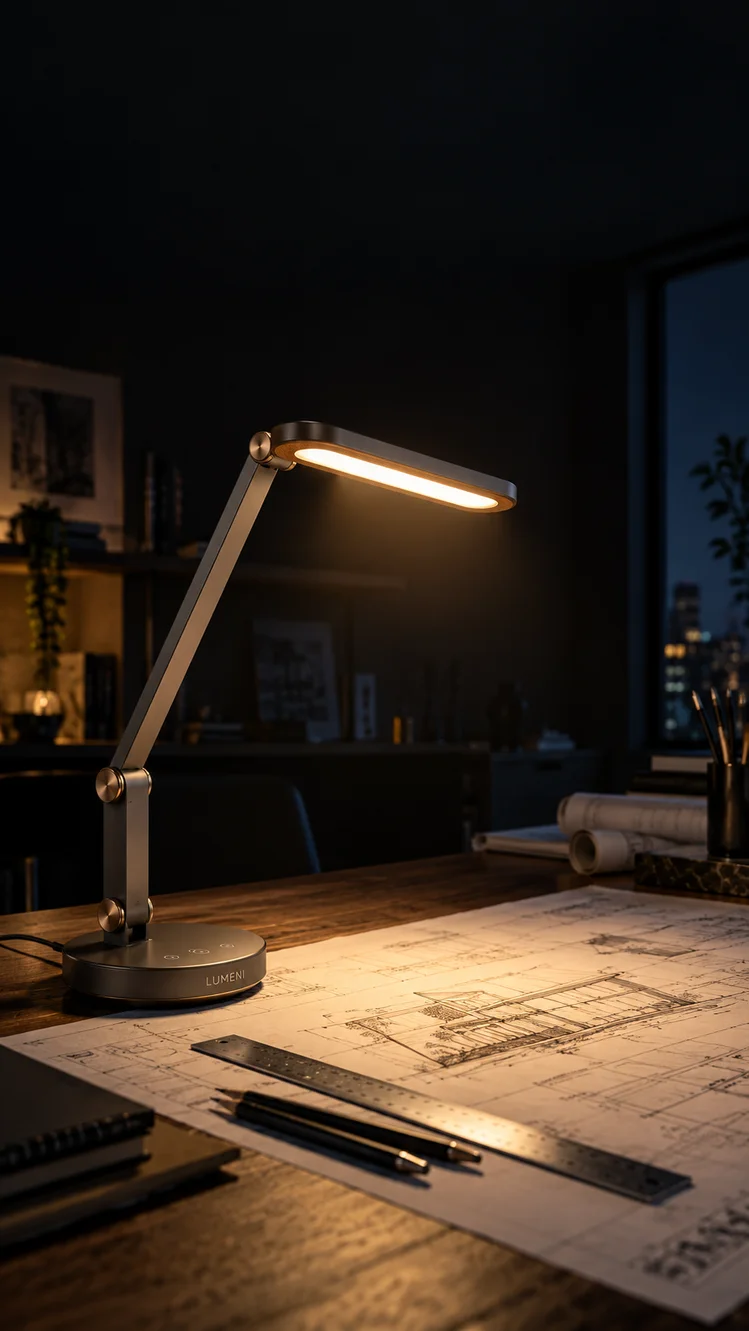
Lumeni Desk Lamp Last Lit Desk Ad
THE LAST LIT DESK — LUMENI DESK LAMP / Aspect Ratio: 9:16 Portrait Create "THE LAST LIT DESK," a premium architectural product-campaign photograph for the Lumeni Desk Lamp. The concept is built on the creative seed: the lamp is the only lit object in a dark architect's studio at night, and its beam is caught in the act of reading a half-finished drawing. The mood is quiet, focused, exact — the object every designer wants on their desk. Preservation clause: Reproduce the Lumeni Desk Lamp faithfully from the uploaded reference image: the slim vertical column with a rounded dome base, the slender articulated arm with the precision hinge joint, the rectangular flat-panel light head with softly rounded edges and warm wood side accents, the hidden LED panel glowing at full brightness, the small brand mark on the light head, and the USB-C cable curling from the base. Keep the lamp's matte dark-metal finish, the warm wood grain, and exact proportions and geometry. Do not redesign the head, add extra joints, or invent controls. The reference is the sole authority for product identity. Visual idea: A tall vertical 9:16 composition in which the lamp stands on a dark architect's desk and throws a precise, warm pool of light onto a half-finished architectural drawing. The drawing's ink lines and the lamp's beam are the two graphic elements; everything else recedes into darkness. The lamp is the hero and the only light source. Product orientation and pose: Stand the lamp upright on its dome base at the left third of the frame, the articulated arm angled so the flat-panel head tilts down and toward the drawing at approximately 40 degrees. Rotate the head slightly toward camera so the glowing LED panel is partially visible — the viewer must see that the light is on. This pose shows the column, hinge, head and base in one readable silhouette and differs completely from the reference's frontal product shot. Environment and spatial relationships: A real, dark architect's studio desk at night. The desk surface is matte dark timber. On it: a large half-finished architectural drawing (plan/elevation linework, visible scale ruler edge), a steel ruler, a few pencils, and rolled trace paper in the deep background. The lamp occupies the left third; the drawing spreads across the center and right. Background beyond the desk falls to near-black with only faint shelving edges. Camera and composition: Vertical 9:16 hero, full-frame camera with a 50 mm lens, positioned at desk height approximately 2.5 m from the lamp, slight three-quarter angle. Frame the lamp full-height on the left third with generous dark negative space at the top for campaign text. Keep the lamp and the lit portion of the drawing critically sharp; let the background dissolve. Supporting elements and human presence: Product only. No people, no hands. Supporting elements are limited to the drawing, ruler, pencils and rolled trace — all clearly secondary. Lighting setup: The lamp's own LED panel is the key light: a warm-white 3000 K source, small and close, throwing a defined pool of light with natural inverse-square falloff onto the drawing. The beam creates soft shadows of the ruler and pencils stretching away from the lamp, and a gentle gradient across the paper. A very dim, cool 6500 K spill from a distant unseen window at camera-right provides just enough separation to read the lamp's dark column against the black background — keep it at least 4 stops under the key. The LED panel itself should read as a bright, clean rectangle with no bloom or halation beyond what a real exposure would show. Shadows must be dense, attached and directionally consistent with the lamp head position. Visual hierarchy: First, the glowing lamp head and its beam on the drawing. Second, the lamp's full silhouette. Third, the half-finished drawing lines revealed by the light. Fourth, the dark studio falling away. Realism notes: Physically accurate single-source lighting with real falloff; no fill light lifting the shadows artificially. True paper texture under raking light, believable ink linework, accurate wood grain on the lamp accents. No lens flare, no dust particles, no glow effects. The image must be achievable as one long-exposure photograph in a real dark studio.
Why use this prompt?
A reusable desk-lamp advertising prompt built around the lamp as the sole light in a dark studio, a warm beam reading a half-finished drawing, and dark copy space for design-object creative.
- ✨ Single-Source Drama: The lamp's own 3000K LED is the key — real falloff, dense attached shadows.
- ✨ Type-Ready Framing: Reserve the upper 9:16 frame as dark negative space for headlines.
- ✨ Exact Product Control: Preserve the Lumeni column, hinge, panel head, wood accents and cable.