
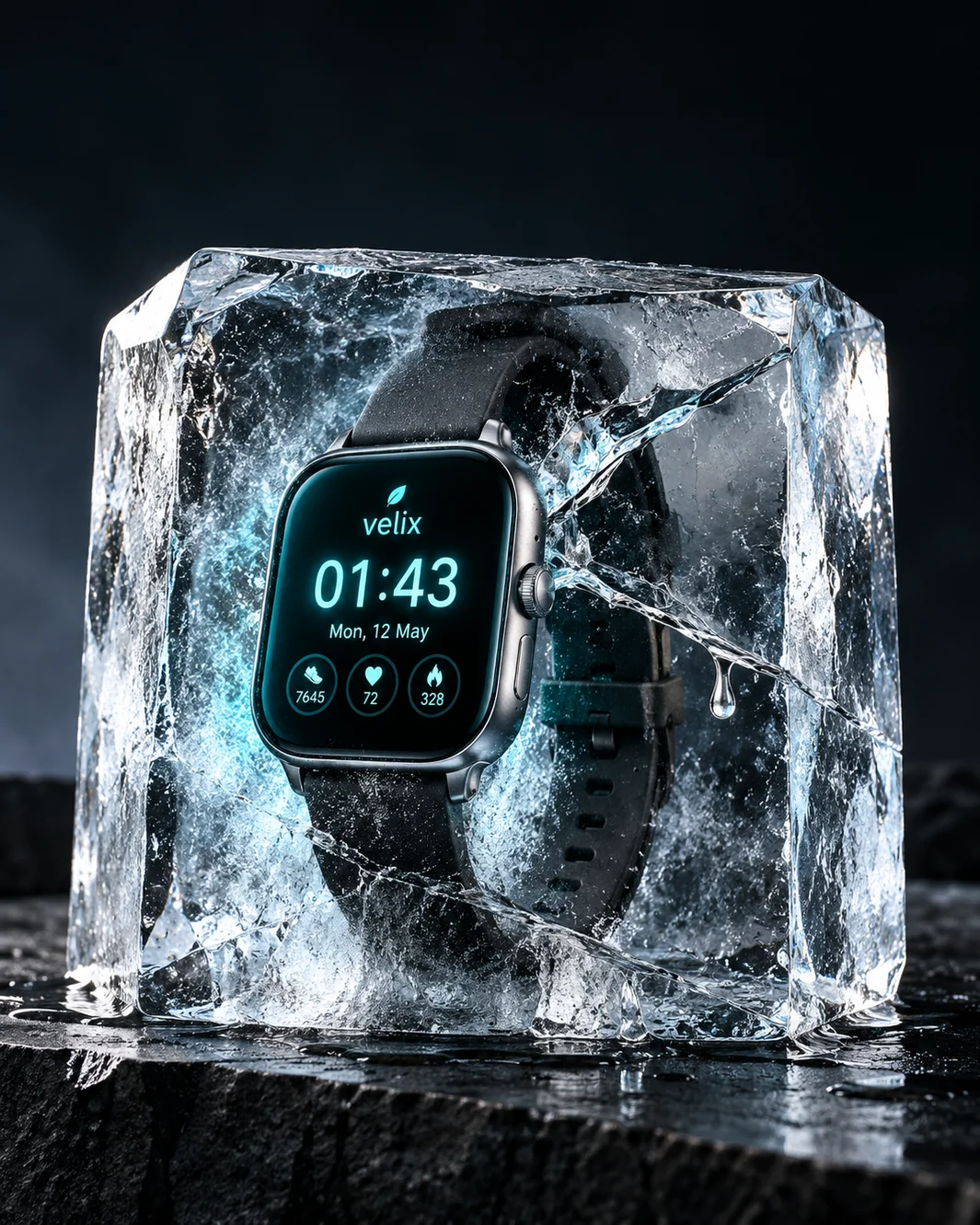
Velix Smartwatch Second Frozen Hero
Create "THE SECOND, FROZEN," a premium wearable-technology hero photograph built on a single arresting paradox: perfect movement, captured at the instant before it happens. The Velix Aura 2 smartwatch stands vertically inside a block of optically clear, lightly cracked ice that reads more like solidified time than frozen water. One fracture line freezes directly against the case edge, and the watch's screen — glowing teal at approximately 01:43:08 — is the sole source of color temperature contrast in an otherwise cold, disciplined scene. A single droplet of meltwater hangs from a fracture tip, the only element that suggests the block is impermanent. Preservation clause: Reproduce the watch exactly as shown in the reference image: graphite-black rounded-square aluminum case with polished chamfered edges, slim crown and elongated side button on the right edge, edge-to-edge gently curved display with vibrant teal glow, exact "01:43" time and ring-completion interface layout, textured black sport strap with perforated adjustment holes, and Velix branding on the upper case lip. The uploaded image is the source of truth for material, color, typography and proportions. Keep all branding and display elements crisp and undistorted through the ice; do not invent or soften brand marks. No front-logo distortion and no invented rear sensors. Product orientation and pose: Stand the watch vertically on its side edge, screen facing the camera and tilted approximately 8 degrees toward the viewer so the teal display is fully legible. Rotate the strap so it rises upward and curls gently against the top of the ice, making the product's profile unmistakable and avoiding the flat frontal pose of the reference photo. Environment and spatial relationships: Encase the watch in a rectangular block of clear ice roughly four times the watch's footprint, its top and front faces beveled like a cut gemstone. The ice sits on a broad slab of dark honed basalt that anchors the image with mass and permanence. The block should dominate the lower two-thirds of the frame and feel excavated rather than placed—like a sample pulled from deep winter. Camera and composition: Vertical 4:5 hero composition. Shoot from a three-quarter eye-level viewpoint using an 85 mm lens on a full-frame camera at approximately f/8 for tight product sharpness with controlled micro-texture falloff in the ice. Center the watch's screen on the upper third intersection; keep the top of the frame darker and quieter so copy can sit above the scene without fighting the product. Avoid any symmetrical dead-center composition. Supporting elements and human presence: None. No wrist, no props, no packaging. Lighting setup: Key light is a large rectangular softbox (approximately 90 x 120 cm) positioned camera-left, angled 30 degrees down toward the ice block, color temperature near 5600 K; this produces long soft reflections through the ice volume and one broad readable highlight on the case chamfer. A small white bounce card at camera-right, placed low near the basalt slab, lifts the strap texture and deepens the teal-to-black gradient on the screen. A narrow strip light behind and slightly above the block (daylight balanced) creates a thin separation edge along the ice's top bevel and gives the cracked fractures their internal sparkle without haloing. The watch's own display glow (cool teal, approximately 7500 K equivalent) illuminates adjacent ice from within, casting a faint cyan bloom inside fracture lines; this is the only warm-to-cool contrast in the scene. Render physically accurate ice refraction, internal fracture scattering and dense contact shadows where the block meets the basalt. Keep the basalt surface mostly matte with one soft sheen pool beneath the ice from the key softbox. Exposure priority on the teal display—no clipped highlights on the screen or blown-out ice edges. Visual hierarchy: First, the glowing teal watch face. Second, the fracture frozen against the case edge. Third, the hanging meltwater droplet. Fourth, the monumental ice volume and dark slab that make the scene feel permanent. Realism notes: True macro-level ice optics: air-free clarity with internal cracks, no cartoon sparkles, no fake lens flares, no floating dust particles. The ice should refract the watch convincingly without warping brand marks beyond what real ice would do. Color grade restrained and cold, with the teal display as the single saturated accent. The finished image should be achievable as one practical still-life photograph with a real ice block and one camera.
Why use this prompt?
A reusable smartwatch advertising prompt built around a glowing watch face frozen in cracked ice, teal-on-black contrast, and dark copy space for premium wearable creative.
- ✨ Arresting Paradox: Encase the watch in clear ice — perfect movement captured before it happens.
- ✨ Type-Ready Framing: Keep the upper frame dark and quiet for campaign headlines.
- ✨ Exact Product Control: Preserve the Velix case, teal display, strap, crown and branding through the ice.